Choosing the right FiveM host in 2025 is critical for delivering a smooth, lag-free roleplay experience to your community. With hundreds of hosting providers on the market, understanding the technical requirements, infrastructure quality, and bundled features can make or break your server’s success. This guide walks you through every factor—from CPU architecture to network resilience—so you can confidently select a FiveM host that scales with your player base and meets the demands of modern GTA V multiplayer.
Why Infrastructure Matters for FiveM Hosting
FiveM servers are CPU-intensive applications. Unlike traditional game servers that spread load across multiple cores, FiveM’s primary thread relies heavily on single-core performance. This means clock speed trumps core count. A processor like the AMD Ryzen 9 7950X3D, which boosts up to 5.7 GHz with 3D V-Cache, delivers exceptional per-thread performance and low-latency memory access—ideal for handling dozens of synchronized players, scripts, and vehicle physics in real time.
Memory is equally important. FiveM servers with custom frameworks (ESX, QBCore, VRP) and hundreds of add-ons can easily consume 8–16 GB of RAM. Opting for DDR5 ECC RAM ensures data integrity under sustained load and prevents silent corruption that can lead to crashes during peak hours. At Nexus Games, all FiveM hosting plans include 32–128 GB of DDR5 ECC, allocated exclusively to your instance.
Storage: NVMe SSD for Instant Resource Streaming
FiveM relies on rapid file I/O to stream custom maps, vehicles, and textures to connecting players. Traditional SATA SSDs cap out around 550 MB/s sequential reads; NVMe SSDs push 3,500–7,000 MB/s, reducing load times from minutes to seconds. This translates to shorter connection queues and a better first impression for new players exploring your server.
Network Backbone: 1 Gbps Uplink and Game-Grade DDoS Protection
Roleplay servers attract both legitimate traffic and malicious actors. A 1 Gbps uplink ensures bandwidth headroom for 200+ concurrent players plus voice chat, while Game Anti-DDoS filtering mitigates volumetric attacks (UDP floods, amplification) without adding latency. Nexus Games deploys multi-layered DDoS mitigation at the network edge, so your server stays online even during targeted assaults.

Essential Features to Look for in a FiveM Host
Beyond raw hardware, the control panel, automation tools, and bundled licenses determine how quickly you can launch and scale your server. Here are the must-have features in 2025:
1. Patreon Key Included
Cfx.re requires server owners to link a Patreon subscription (Tier 1 or higher) to unlock keymaster slots beyond 32 players. Reputable FiveM hosts include this key in the monthly fee, saving you $5–$15 and eliminating setup friction. Nexus Games bundles a Patreon key with every plan, automatically provisioned upon deployment.
2. One-Click Mod & Framework Installation
Manually uploading ESX, QBCore, or vMenu through FTP is tedious and error-prone. A modern panel should offer one-click installers for popular frameworks, vehicle packs, and MLOs. The Nexus Games panel integrates a curated library of pre-configured resources, so you can spin up a fully functional roleplay server in under 10 minutes.
3. Automatic Backups and Rollback
Database corruption or a faulty script update can wipe hours of player progress. Daily automatic backups with one-click restore ensure you never lose critical data. Nexus Games retains 7 days of snapshots, stored off-node for disaster recovery.
4. Real-Time Resource Monitoring
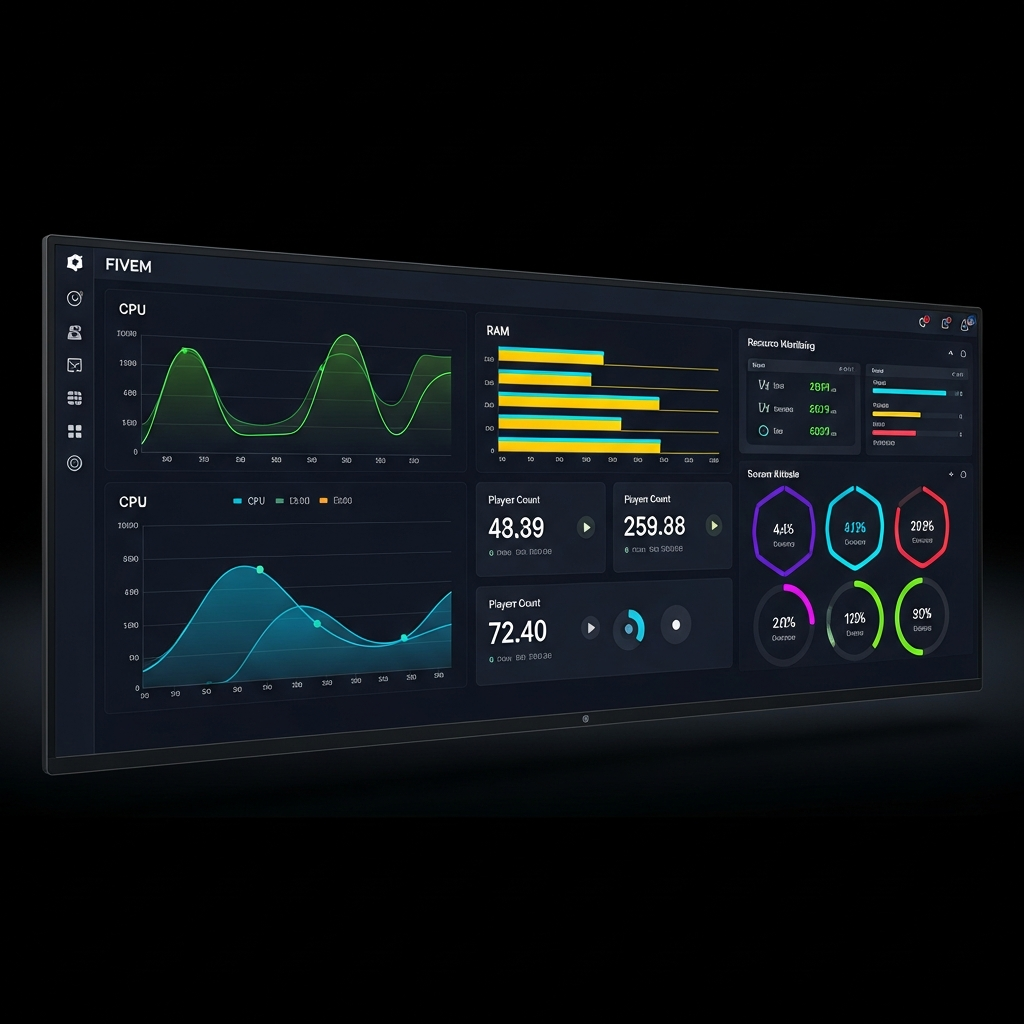
CPU spikes, memory leaks, and script loops can crash your server without warning. A good panel surfaces real-time graphs for CPU, RAM, network, and disk I/O, plus per-resource profiling to identify bottlenecks. The Nexus panel exposes FiveM’s built-in profiler data directly in the dashboard, so you can optimize or disable heavy scripts on the fly.
5. Scalability: Instant Plan Upgrades
Player counts fluctuate with events, marketing campaigns, and seasonal trends. Your host should allow seamless vertical scaling—adding RAM, CPU allocation, or slot capacity—without downtime. Nexus Games supports in-place upgrades via the panel; changes take effect within 60 seconds.
| Feature | Why It Matters | Nexus Games |
| Patreon Key | Unlock >32 slots | ✅ Included |
| AMD Ryzen 9 7950X3D | High single-thread clock | ✅ 5.7 GHz boost |
| DDR5 ECC RAM | Data integrity, low latency | ✅ 32–128 GB |
| NVMe SSD | Fast resource streaming | ✅ Enterprise-grade |
| Game Anti-DDoS | Uptime during attacks | ✅ Multi-layer |
| Automatic Backups | Data safety | ✅ 7-day retention |
Pricing Models: Shared Slots vs. Dedicated Resources
FiveM hosting typically falls into two categories: slot-based (shared CPU/RAM) and resource-based (dedicated vCPU/RAM pools). Understanding the tradeoffs is key to avoiding performance bottlenecks.
Slot-Based Hosting
You pay per player slot (e.g., $0.50/slot for 64 slots = $32/month). The host oversells CPU and RAM across multiple tenants on the same node. Performance degrades during peak hours when neighbors spike usage. Slot-based plans work for small test servers (<32 players) but struggle under heavy script load.
Dedicated Resource Hosting
You reserve fixed vCPU cores and RAM (e.g., 4 vCPU + 16 GB = $18/month). Resources are isolated via KVM virtualization, guaranteeing consistent performance regardless of neighbor activity. This model scales better for 100+ player servers running complex frameworks. Nexus Games uses KVM-based resource allocation, so your FiveM instance never competes for cycles.
Price-to-Performance Benchmark
In 2025, expect to pay $2.94–$4.91/month for entry-level FiveM hosting (32 slots, 4 GB RAM, shared CPU). Mid-tier plans (64 slots, 8 GB, dedicated 4-core) range $8–$15/month. High-performance setups (128+ slots, 16 GB+, Ryzen 9 7950X3D) start around $18–$25/month. Nexus Games’ FiveM plans begin at $2.94 with Patreon key and DDoS protection included, offering exceptional value for roleplay communities.
Advanced Considerations: Latency, Location, and Support
Geographic Proximity
FiveM transmits player position, vehicle sync, and voice data 20–30 times per second. Even 50 ms of added latency causes noticeable desyncs. Choose a datacenter within 500 miles of your target audience. Nexus Games operates nodes in North America and Europe, ensuring sub-30 ms ping for most players.
Uptime SLA and Incident Response
A 99.9% uptime SLA sounds impressive—until you realize it permits 43 minutes of downtime per month. Look for hosts offering 99.95%+ SLA with proactive monitoring and 24/7 technical support. Nexus Games guarantees 99.95% uptime and maintains a sub-15-minute response time for critical tickets.
Database Optimization
ESX and QBCore store player inventories, vehicles, and economy data in MySQL/MariaDB. Poorly tuned databases cause 2–5 second freezes during transactions. Advanced hosts provide tuned MySQL instances with query caching, connection pooling, and SSD-backed storage. Nexus Games pre-configures MariaDB 10.11 with InnoDB optimizations for FiveM workloads.
VPS Flexibility for Custom Builds
Some server owners prefer full control over the OS, web server, and auxiliary services (Discord bots, forums, voice servers). A KVM VPS running Linux or Windows lets you install FiveM manually and colocate related services. Nexus Games offers Linux VPS and Windows VPS plans with the same Ryzen 9 7950X3D hardware, ideal for experienced administrators.
For additional guidance on FiveM server security and optimization, consult the official Cfx.re server manual.
Conclusion: Selecting a FiveM host in 2025 demands scrutiny of CPU architecture, memory quality, DDoS resilience, and panel automation. Prioritize providers offering AMD Ryzen 9 7950X3D processors, DDR5 ECC RAM, NVMe storage, and bundled Patreon keys. Nexus Games delivers all these features starting at $2.94/month, backed by 24/7 support and a 99.95% uptime guarantee—making it the optimal choice for roleplay communities of any size.
FAQ
What CPU specs should I prioritize when choosing a FiveM host?
Focus on single-core clock speed over core count. FiveM’s main thread is single-threaded, so a processor like the AMD Ryzen 9 7950X3D with 5.7 GHz boost and 3D V-Cache delivers far better performance than older Xeon chips with more cores but lower clocks. Nexus Games uses exclusively Ryzen 9 7950X3D hardware for all FiveM plans.
Do I need a Patreon key, and is it included with hosting?
Yes—Cfx.re requires a Patreon subscription (Tier 1+) to unlock keymaster slots beyond 32 players. Reputable hosts like Nexus Games include the Patreon key in every FiveM plan, automatically provisioned at deployment, saving you $5–$15/month and setup hassle.
How much RAM do I need for a 64-player roleplay server with ESX or QBCore?
A fully loaded ESX/QBCore server with custom vehicles, MLOs, and 50+ active scripts typically requires 8–12 GB of RAM. For 64 concurrent players, allocate at least 12 GB to avoid memory pressure. Nexus Games plans include DDR5 ECC RAM in 8 GB, 16 GB, and 32 GB+ tiers, with instant upgrades available via the panel.