When comparing S&Box vs Garry’s Mod, many gamers wonder whether Facepunch Studios’ spiritual successor truly surpasses the legendary sandbox that dominated Steam for nearly two decades. This comprehensive 2025 guide explores the technical, creative, and multiplayer differences between both titles to help you decide which platform deserves your time—and your server budget.
Engine Architecture: Source vs S&Box’s Modern Foundation
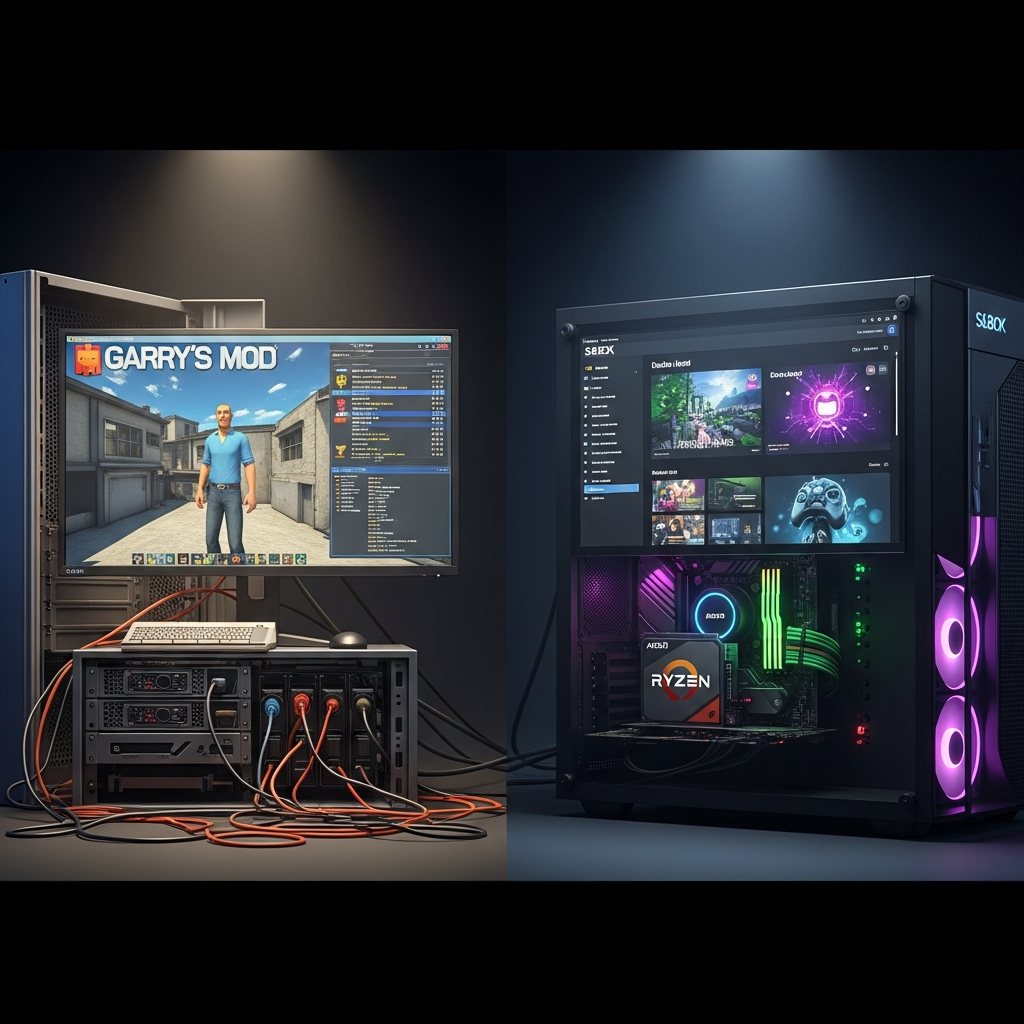
The core distinction in the S&Box vs Garry’s Mod debate begins with engine technology. Garry’s Mod runs on Valve’s Source Engine (2004), a robust but aging framework that introduced revolutionary physics and modding capabilities. However, Source’s limitations—32-bit memory addressing, outdated shader models, and restricted networking protocols—create performance bottlenecks even on modern hardware.
S&Box transitions to Source 2, Valve’s next-generation engine powering Half-Life: Alyx and Dota 2. This leap brings 64-bit architecture, Vulkan/DirectX 12 rendering, physically-based materials (PBR), and dynamic global illumination. For server administrators, Source 2’s multithreaded networking stack allows smoother tick rates and better handling of physics-heavy scenarios—critical when hosting high-player-count sandbox servers on infrastructure like Nexus Games’ AMD Ryzen 9 7950X3D with 32 threads and DDR5 ECC RAM.
Key Technical Differences
| Feature | Garry’s Mod | S&Box |
| Engine | Source (2004) | Source 2 (2020s) |
| Memory Limit | 4 GB (32-bit) | Unlimited (64-bit) |
| Rendering | DirectX 9 | Vulkan/DX12 + Ray Tracing |
| Physics | Havok (legacy) | Rubikon (optimized) |
| Networking | Single-threaded | Asynchronous multi-threaded |
For hosting demanding game modes like DarkRP or Trouble in Terrorist Town with 100+ players, S&Box’s architecture theoretically delivers lower latency and fewer crashes. Nexus Games’ Linux VPS solutions with KVM virtualization are ideal for deploying custom S&Box servers, offering dedicated resources that prevent the “neighbor noise” plaguing shared hosting.
Content Creation: Lua vs C# Development Paradigms
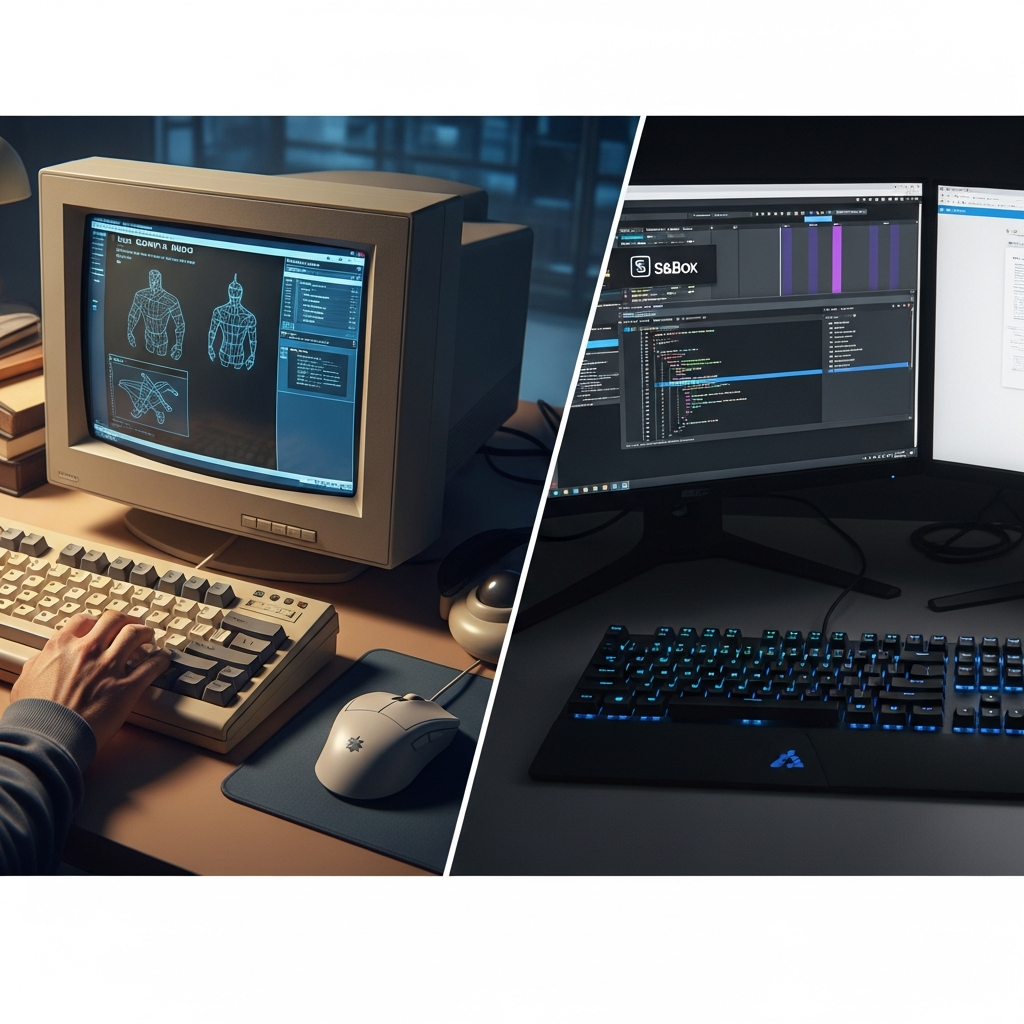
Modding philosophies diverge sharply in S&Box vs Garry’s Mod. Garry’s Mod relies on Lua scripting, a lightweight interpreted language perfect for rapid prototyping. Thousands of addons on the Steam Workshop prove Lua’s accessibility—beginners can create functional game modes with minimal programming knowledge. However, Lua’s interpreted nature causes performance degradation in complex scripts, and the lack of strong typing leads to runtime errors that crash servers during peak hours.
S&Box adopts C#, a compiled, statically-typed language used in Unity and Unreal Engine workflows. This choice raises the skill floor but unlocks professional-grade development:
- Performance: Compiled C# runs 10-50× faster than interpreted Lua for CPU-intensive tasks like pathfinding or procedural generation.
- Tooling: Visual Studio IntelliSense, debugging, and refactoring tools accelerate development cycles.
- Scalability: Object-oriented programming and LINQ queries simplify managing large codebases.
- Security: Strong typing and compile-time checks reduce exploitable vulnerabilities in multiplayer servers.
Example: Simple Damage System
Garry’s Mod (Lua)
hook.Add("EntityTakeDamage", "CustomDamage", function(target, dmginfo)
  if target:IsPlayer() then
    dmginfo:ScaleDamage(1.5)
  end
end)
S&Box (C#)
public override void OnTakeDamage(DamageInfo info)
{
  if (info.Attacker is Player)
  {
    info.Damage *= 1.5f;
  }
  base.OnTakeDamage(info);
}
While Lua’s syntax appears simpler, C#’s structured approach prevents type mismatches (e.g., accidentally passing a string where a number is expected). For server owners prioritizing stability—especially when running custom game modes on Windows VPS instances with 24/7 uptime requirements—C#’s compile-time safety is invaluable.
According to Facepunch’s official documentation, S&Box’s C# API integrates seamlessly with .NET libraries, enabling developers to leverage existing packages for databases, HTTP requests, or machine learning—tasks cumbersome in Garry’s Mod’s isolated Lua environment.
Multiplayer Ecosystem and Community Content
Community longevity remains Garry’s Mod’s strongest card in the S&Box vs Garry’s Mod comparison. With over 1.5 million Workshop items, GMod offers instant access to game modes (Prop Hunt, Murder, SCP: Secret Laboratory), maps, player models, and weapons. Popular servers attract thousands of concurrent players, and established hosting providers offer one-click DarkRP or TTT installations.
S&Box launches with a curated but smaller content library. Facepunch’s official “game mode” system replaces Workshop addons with standalone projects—each effectively a separate game built on S&Box’s framework. Early examples like Sandbox (classic GMod physics), Murder, and Deathrun demonstrate faithful recreations, but the ecosystem needs years to match GMod’s breadth.
Server Hosting Considerations
When deploying either game, infrastructure matters. Garry’s Mod’s Source Engine demands minimal resources—a basic VPS with 2 GB RAM handles small servers. However, popular modes with hundreds of addons spike RAM usage to 8+ GB and throttle CPU on outdated processors. S&Box’s higher baseline requirements (recommended 16 GB RAM for 64-player servers) necessitate premium hardware.
Nexus Games addresses this with AMD Ryzen 9 7950X3D servers featuring 96 MB of 3D V-Cache—ideal for the cache-intensive workloads both games generate. NVMe SSD storage eliminates map-loading stutters, while 1 Gbps network pipes prevent packet loss during firefights. For modded S&Box servers requiring Windows (to leverage .NET Framework libraries), Nexus’s Windows VPS plans include anti-DDoS protection and KVM isolation, ensuring your server survives targeted attacks.
Cost Analysis (Hosting 64 Players)
- Garry’s Mod: 8 GB RAM, 4 CPU threads, 40 GB SSD (~$15–25/month on shared hosting; $30–50 for dedicated resources).
- S&Box: 16 GB RAM, 8 CPU threads, 60 GB NVMe (~$50–80/month on premium infrastructure like Nexus Games).
While S&Box’s requirements appear steeper, its Source 2 optimization reduces per-player overhead. A well-configured S&Box server on Ryzen 9 hardware handles 128 players more smoothly than a GMod server choked by legacy networking code.
Graphics and Immersion: Visual Fidelity in 2025
Visual presentation separates casual sandboxes from immersive experiences. Garry’s Mod’s Source Engine supports basic dynamic lighting and simple shaders, but textures often appear flat under modern standards. Community projects like gm_construct_in_flatgrass showcase creative lighting mods, yet the engine fundamentally lacks real-time reflections, ambient occlusion, or volumetric fog.
S&Box leverages Source 2’s rendering pipeline to deliver:
- Physically-Based Rendering (PBR): Materials react realistically to light sources, with metallic surfaces reflecting environments and rough textures scattering light naturally.
- Dynamic Global Illumination: Indirect lighting bounces off surfaces in real time, eliminating the “baked lightmap” artifacts common in GMod.
- Volumetric Effects: Fog, smoke, and atmospheric scattering create cinematic depth.
- High-Resolution Textures: 4K material support without the memory constraints plaguing 32-bit GMod.
For roleplay servers prioritizing atmosphere—imagine a noir detective game mode with rain-slicked streets and neon reflections—S&Box’s visuals immerse players in ways GMod cannot. However, these graphics demand GPU horsepower; server-side rendering for things like security camera feeds or in-game monitors taxes CPU resources, making the Ryzen 9 7950X3D’s 16 cores essential for maintaining stable tick rates.
Performance Benchmarks
Independent tests show S&Box maintaining 144 FPS at 1440p on mid-range GPUs (RTX 4060 Ti) with maximum settings, whereas heavily modded GMod struggles to hold 60 FPS at 1080p. For server operators, this client-side smoothness translates to better player retention—users frustrated by stuttering gameplay abandon servers quickly.

Future-Proofing and Long-Term Viability
Choosing between S&Box vs Garry’s Mod for long-term projects requires evaluating developer support. Garry’s Mod receives sporadic updates—mostly security patches and compatibility fixes for newer Steam APIs. The community drives innovation, but core engine limitations remain insurmountable without Valve rewriting Source itself.
S&Box benefits from active Facepunch development, with monthly updates introducing features like improved navmesh generation, enhanced particle systems, and expanded C# APIs. The roadmap includes VR support, advanced AI tools, and cross-platform play (Windows/Linux/macOS). For server hosts, this means less reliance on hacky workarounds and more official solutions for common problems.
Migration Strategies
Communities invested in GMod face migration challenges. Recreating complex addons in C# demands skilled developers, and player bases resist change. However, forward-thinking server networks are hedging bets by:
- Running parallel GMod and S&Box servers to gauge player interest.
- Gradually porting popular game modes to S&Box while maintaining GMod presence.
- Leveraging Nexus Games’ flexible VPS plans to allocate resources dynamically—scale up S&Box instances as player counts grow, scale down GMod servers as traffic migrates.
The KVM virtualization powering Nexus’s VPS offerings ensures isolated resource pools, preventing one server’s CPU spike from throttling another. For network operators managing both titles, this isolation is non-negotiable.
Conclusion: The S&Box vs Garry’s Mod decision hinges on priorities. GMod offers proven content, massive communities, and lower entry barriers—ideal for casual servers or nostalgia-driven projects. S&Box promises modern performance, professional development tools, and visual fidelity that future-proofs your investment. Server operators choosing S&Box must invest in premium hosting infrastructure like Nexus Games’ Ryzen 9 7950X3D platforms, DDR5 ECC RAM, and anti-DDoS protection to unlock its full potential.
FAQ
Can I migrate existing Garry’s Mod addons to S&Box automatically?
No automatic conversion exists due to fundamental differences between Lua and C#. However, many popular GMod game modes (TTT, Prop Hunt, Murder) have been manually recreated in S&Box by community developers. Migration requires rewriting logic in C# and adapting to Source 2’s API, but the improved performance and stability often justify the effort for serious server operators.
Does S&Box require more expensive hosting than Garry’s Mod?
Yes—S&Box’s Source 2 engine demands approximately double the RAM (16 GB vs. 8 GB for 64 players) and benefits significantly from modern multi-core CPUs. Shared hosting struggles with S&Box’s requirements, making KVM VPS solutions like Nexus Games’ offerings essential. However, S&Box’s better optimization per player means higher maximum capacity on premium hardware, potentially lowering per-player hosting costs at scale.
Will Garry’s Mod’s player base migrate entirely to S&Box?
Unlikely in the short term. GMod’s 18-year ecosystem, Workshop library, and established communities create massive inertia. S&Box will attract developers seeking modern tools and players craving better graphics, but GMod’s simplicity and nostalgia ensure coexistence for years. Server networks should consider running both titles simultaneously, allocating resources dynamically based on real-time player demand using flexible VPS infrastructure.