Learning how to craft diamond sword Minecraft is one of the most exciting milestones for any player in 2025. The diamond sword remains the strongest melee weapon in vanilla Minecraft, offering 7 attack damage and excellent durability. Whether you’re exploring the Nether, fighting the Ender Dragon, or defending your base from hostile mobs, mastering the craft diamond sword Minecraft process is essential for survival and progression in your world.
Why the Diamond Sword Matters in Minecraft 2025
The diamond sword has been a cornerstone weapon since Minecraft’s early days, and in 2025 it continues to dominate as the preferred melee choice before upgrading to Netherite. With a base attack damage of 7 (3.5 hearts) and 1561 durability points, this weapon outperforms iron, stone, and wooden swords significantly. When you craft diamond sword Minecraft style, you’re investing in a tool that will serve you through countless battles.
Diamond swords can be enchanted with powerful enhancements like Sharpness V, Looting III, Sweeping Edge III, Fire Aspect II, Knockback II, and Unbreaking III. These enchantments transform your basic diamond sword into a devastating weapon capable of one-shotting most common mobs and dealing massive damage to bosses. For players running multiplayer servers on robust infrastructure like Minecraft server hosting powered by AMD Ryzen 9 7950X3D processors, having properly crafted and enchanted diamond swords becomes crucial for PvP combat and cooperative boss fights.
Combat Statistics and Damage Output
Understanding the mechanics behind your diamond sword helps optimize your combat strategy. The weapon deals 7 base damage per hit, with a cooldown of 0.625 seconds in Java Edition and instant attacks in Bedrock Edition. Critical hits (achieved by jumping and attacking while falling) multiply damage by 1.5×, resulting in 10.5 damage (5.25 hearts) per critical strike with an unenchanted diamond sword.
| Sword Type | Attack Damage | Durability | DPS (Java) |
| Wooden Sword | 4 | 59 | 6.4 |
| Stone Sword | 5 | 131 | 8.0 |
| Iron Sword | 6 | 250 | 9.6 |
| Diamond Sword | 7 | 1561 | 11.2 |
| Netherite Sword | 8 | 2031 | 12.8 |
These statistics demonstrate why the diamond sword represents such a significant upgrade from iron-tier weapons. For server administrators managing large communities, ensuring players can efficiently gather diamonds and craft these weapons enhances overall gameplay experience and server engagement.
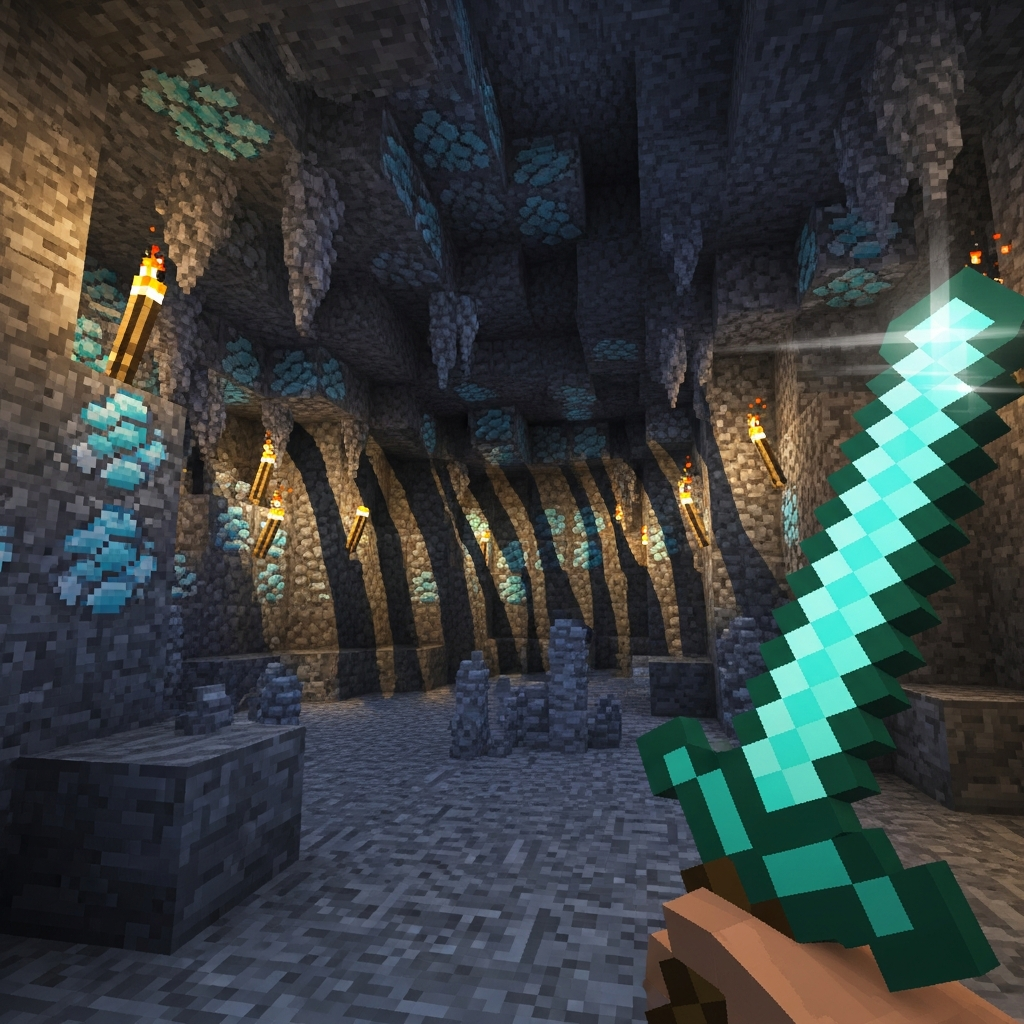
Step-by-Step Guide to Craft Diamond Sword Minecraft
The process to craft diamond sword Minecraft weapons requires specific materials and a crafting table. The recipe is straightforward but demands significant resource investment. Here’s everything you need to know about gathering materials and executing the crafting process successfully.
Required Materials and Resources
To craft a single diamond sword, you’ll need exactly 2 diamonds and 1 stick. Diamonds are found primarily between Y-levels -64 and 16 in the Overworld, with the highest concentration occurring around Y-level -59 in 2025’s updated ore distribution. A single diamond ore block drops one diamond when mined with an iron pickaxe or better, though Fortune III enchantment can increase this yield up to 4 diamonds per ore.
Sticks are crafted from wooden planks using a 2×1 vertical pattern in your crafting grid. Any wood type works—oak, birch, spruce, jungle, acacia, dark oak, mangrove, cherry, or bamboo planks all produce identical sticks. For players on high-performance Minecraft servers with pre-installable modpacks, certain mods may introduce alternative stick recipes or diamond-finding mechanics.
The Crafting Recipe Pattern
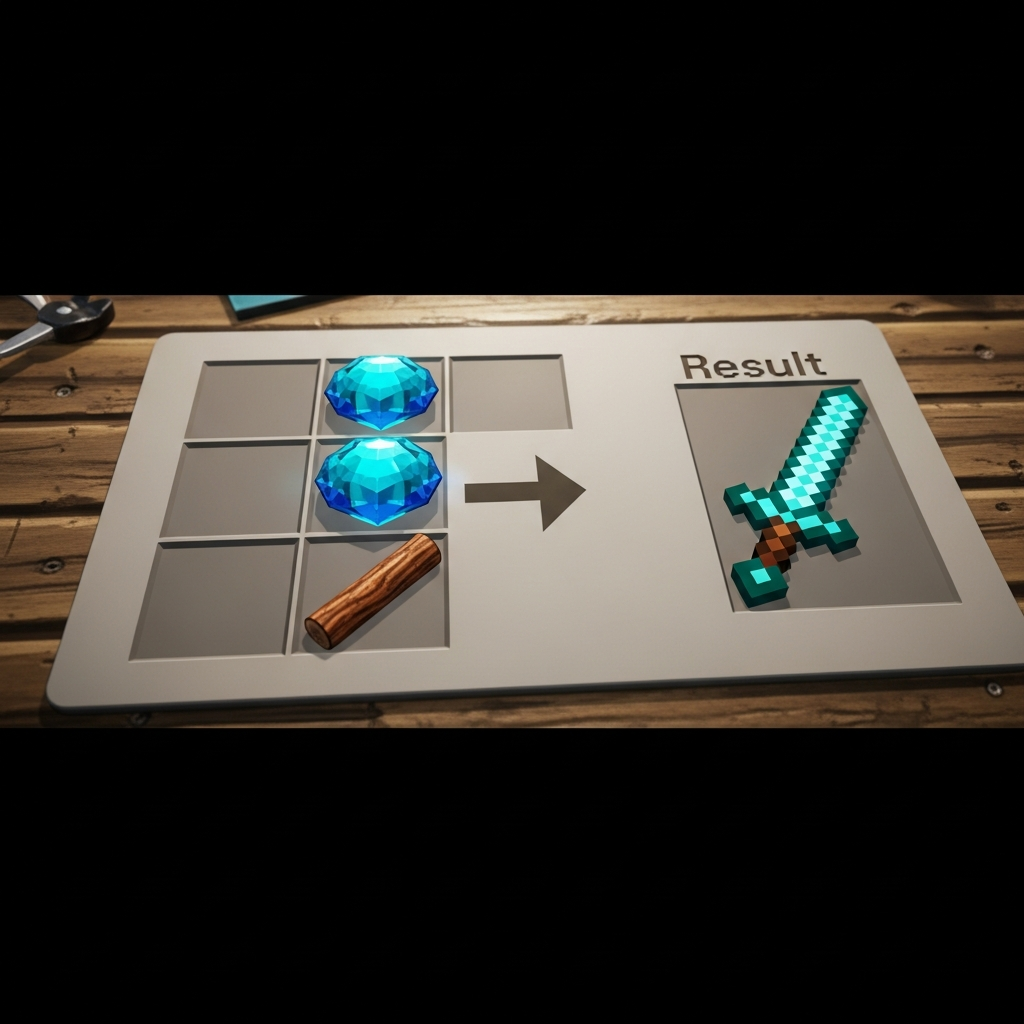
Once you’ve gathered your materials, access a crafting table (crafted from 4 wooden planks in a 2×2 pattern). The diamond sword recipe follows this exact placement:
[Empty] [Diamond] [Empty]
[Empty] [Diamond] [Empty]
[Empty] [Stick]   [Empty]
Place one diamond in the top-center slot of the 3×3 crafting grid, a second diamond directly below it in the middle-center slot, and finally one stick in the bottom-center slot. This vertical alignment is crucial—horizontal or diagonal arrangements won’t produce a sword. Once properly arranged, the diamond sword will appear in the output slot, ready to be added to your inventory.
Alternative Methods to Obtain Diamond Swords
While crafting remains the primary method, several alternative acquisition routes exist in Minecraft 2025. Chest loot in structures like End Cities, Bastion Remnants, and Woodland Mansions occasionally contain diamond swords, sometimes pre-enchanted with valuable enchantments. Trading with Weaponsmith villagers at Master level (requiring significant prior trades) offers diamond swords for 13-27 emeralds, though this method proves expensive.
Mob drops provide another source—zombies, husks, drowned, zombified piglins, and skeleton horsemen have a small chance (8.5% on Hard difficulty) to spawn with diamond swords, which they may drop upon death with Looting enchantment increasing drop rates. For technical players, designing mob farms that filter for rare equipment can yield diamond swords passively. According to the official Minecraft Wiki, these drop rates have remained consistent through recent updates.
Diamond Mining Strategies for Efficient Sword Production
Successfully learning to craft diamond sword Minecraft weapons repeatedly requires establishing efficient diamond mining operations. In 2025, optimal mining strategies have evolved with cave generation updates, offering both traditional and modern approaches.
Strip Mining at Optimal Y-Levels
Strip mining (also called branch mining) at Y-level -59 remains the most consistent diamond-finding method. This technique involves creating a central corridor at the target depth, then mining perpendicular tunnels spaced 2-3 blocks apart to maximize ore exposure while minimizing redundant block breaking. At -59, you’ll encounter the highest diamond density while avoiding excessive lava pools that become more common at deeper levels.
Create your main shaft from the surface down to Y-59 (check coordinates by pressing F3 in Java Edition or enabling coordinate display in Bedrock Edition settings). From your central corridor, mine branches extending 20-30 blocks in cardinal directions, maintaining 2-block spacing between tunnels. This pattern ensures you visually inspect nearly all blocks at the optimal level without wasting time on redundant mining.
Cave Exploration and Lush Cave Systems
The 2021 Caves & Cliffs update revolutionized underground exploration, introducing massive cave systems that expose significantly more ore blocks than previous generation. Exploring these natural caverns at diamond-level depths (-64 to -48) can yield faster diamond collection than strip mining, especially in lush caves and dripstone caverns where visibility is enhanced.
Bring adequate lighting (torches or glowstone), food, weapons, and a water bucket for lava management. Mark your path with torches on one wall (following the “right-hand rule”) to prevent getting lost in sprawling cave networks. The increased ore exposure in large caves often compensates for the dangers of mob spawning and lava lakes.
Fortune Enchantment Multiplication
Once you’ve crafted your first diamond pickaxe, prioritize enchanting it with Fortune III before extensive diamond mining. Fortune III increases average diamond drops from 1 to 2.2 per ore block, effectively more than doubling your diamond yield. This enchantment transforms diamond mining efficiency, allowing you to craft diamond sword Minecraft weapons and tools much faster.
Combine this with an Efficiency V enchantment to mine blocks faster, and Unbreaking III to extend your pickaxe’s lifespan from 1561 uses to approximately 6244 uses. For players managing servers with communities needing equipment, setting up communal Fortune III pickaxes in shared storage can accelerate everyone’s progression. High-performance infrastructure like DDR5 ECC RAM and NVMe SSD storage ensures smooth chunk loading during intensive mining sessions, preventing frustrating lag when exploring large cave systems.
Enchanting Your Diamond Sword for Maximum Effectiveness
After you craft diamond sword Minecraft style, enchanting transforms it from a basic weapon into an endgame tool. Understanding enchantment combinations and application methods optimizes your sword’s performance across all combat scenarios.
Essential Combat Enchantments
Sharpness V remains the most universally valuable damage enchantment, adding 3 damage (1.5 hearts) per level for a total of +15 (7.5 hearts) at maximum level. This brings your total attack damage to 22 (11 hearts) per hit before critical strikes. Alternative damage enchantments like Smite V (extra damage against undead) and Bane of Arthropods V (extra damage against spiders, silverfish, and endermites) offer specialized benefits but lack Sharpness’s universal application.
Looting III increases mob drop rates and maximum drop quantities, essential for farming rare items like wither skeleton skulls, ender pearls, and gunpowder. Each Looting level increases maximum drops by 1 and adds a percentage chance for rare drops. Sweeping Edge III (Java Edition only) increases sweep attack damage from 1 to 75% of the sword’s base damage, devastating grouped enemies.
Utility and Durability Enchantments
Unbreaking III extends your sword’s effective durability from 1561 to approximately 6244 uses by providing a 75% chance per use to avoid consuming durability. Mending allows you to repair your sword using experience orbs, creating a potentially infinite-use weapon when combined with Unbreaking. These two enchantments together ensure your carefully crafted and enchanted sword never needs replacement.
Fire Aspect II sets enemies ablaze for 8 seconds, dealing 4 additional fire damage over time and cooking meat from animals (providing cooked drops instead of raw). Knockback II pushes enemies back 6 blocks per hit, useful for crowd control but sometimes detrimental in enclosed spaces or when trying to combo attacks.
Optimal Enchantment Combinations
The ideal all-purpose diamond sword enchantment setup combines: Sharpness V, Looting III, Sweeping Edge III (Java), Unbreaking III, Mending, Fire Aspect II. This combination costs approximately 50-70 levels when applied through an anvil using enchanted books, but creates a weapon suitable for every combat scenario from mob grinding to boss fights.
For PvP-focused builds, remove Fire Aspect (which can obscure your opponent’s position) and potentially reduce Knockback to I or remove it entirely for combo potential. For mob farming, maximize Looting and consider removing Fire Aspect if you need specific mob drops that fire destroys (like spider eyes or certain modded items).
| Enchantment | Max Level | Primary Benefit | Best For |
| Sharpness | V | +15 damage total | All combat |
| Looting | III | Increased drops | Farming |
| Sweeping Edge | III | 75% sweep damage | Mob groups (Java) |
| Unbreaking | III | ~4× durability | Longevity |
| Mending | I | XP repair | Sustainability |
| Fire Aspect | II | 8 sec burn | PvE combat |
Enchanting Methods and Experience Efficiency
Three primary methods exist for enchanting in Minecraft 2025: direct enchanting table application, combining enchanted books via anvil, and villager trading. The enchanting table method costs 30 levels maximum but provides random enchantments, making it unreliable for specific combinations. Using enchanted books (obtained from villager trading, fishing, or dungeon loot) via anvil allows precise control but accumulates “prior work penalty” that eventually makes items too expensive to modify.
The optimal strategy combines both: enchant your diamond sword directly at the enchanting table surrounded by 15 bookshelves (for maximum level 30 enchantments), then supplement missing enchantments using books from librarian villagers. Trade-lock librarians offering valuable enchantments like Mending, Sharpness V, and Unbreaking III by trading their required items, ensuring permanent access to these books.
For server administrators on platforms offering one-click installable modpacks via CurseForge, enchantment-focused mods can enhance this system, adding new enchantments or modifying the enchanting table mechanics for improved player progression. Always test mod compatibility in staging environments before deploying to production servers with active player bases.
Upgrading to Netherite: Beyond the Diamond Sword
While this guide focuses on how to craft diamond sword Minecraft weapons, understanding the Netherite upgrade path provides crucial endgame context. Netherite swords represent the ultimate melee weapon, offering 8 attack damage (one more than diamond), 2031 durability (470 more than diamond), and unique benefits like fire/lava immunity and knockback resistance when worn as armor.
Netherite Upgrade Process
Unlike other equipment tiers, Netherite items cannot be crafted directly from raw materials. Instead, you must first craft a diamond sword, then upgrade it using a Netherite ingot in a smithing table. This process preserves all existing enchantments, making it the only equipment upgrade that doesn’t require re-enchanting.
Netherite ingots are crafted from 4 Netherite scraps and 4 gold ingots. Netherite scraps come from smelting Ancient Debris, an extremely rare ore found only in the Nether between Y-levels 8-22 (with highest concentration at Y-15). Ancient Debris requires a diamond or Netherite pickaxe to mine and has blast resistance, making it immune to TNT destruction—a property exploited by advanced players using controlled TNT explosions to expose debris more efficiently than traditional mining.
Is the Netherite Upgrade Worth It?
For purely damage-focused builds, the single additional attack point from Netherite provides marginal improvement over diamond. However, the increased durability significantly reduces maintenance costs (fewer repairs), and the enchantment preservation during upgrade saves substantial experience and resources. The fire immunity proves invaluable in Nether exploration and combat against Blazes, Ghasts, and Wither bosses.
Most experienced players maintain multiple diamond swords for different purposes (farming, general combat, PvP) before investing in Netherite upgrades for their primary weapon. On multiplayer servers with active economies, diamond swords often serve as mid-tier tradeable items while Netherite equipment becomes prestige gear for established players.
Conclusion
Mastering how to craft diamond sword Minecraft weapons unlocks crucial combat progression in 2025. With just 2 diamonds and 1 stick arranged vertically in a crafting table, you create a powerful 7-damage weapon that dominates early-to-mid game content. Combine efficient diamond mining at Y-59, Fortune III enchantments, and optimal combat enchantments like Sharpness V and Mending to maximize your sword’s effectiveness and longevity. Whether exploring alone or on robust servers with AMD Ryzen 9 7950X3D processors, the diamond sword remains essential equipment.
FAQ
How many diamonds do I need to craft a diamond sword in Minecraft?
You need exactly 2 diamonds to craft a diamond sword, along with 1 stick. The diamonds must be placed vertically in the top two center slots of a 3×3 crafting grid, with the stick in the bottom center slot. This is one of the most resource-efficient diamond tools since pickaxes require 3 diamonds, axes require 3, shovels require 1, and hoes require 2.
What’s the best Y-level to find diamonds for crafting diamond swords in 2025?
The optimal Y-level for diamond mining in Minecraft 2025 is Y-59, where diamond ore generation reaches its highest concentration. Diamonds can spawn between Y-64 and Y16, but the density increases steadily as you descend, peaking at -59 before lava pools become more problematic at deeper levels. Use strip mining or cave exploration at this level for maximum efficiency.
Can I repair a diamond sword, and what’s the best method?
Yes, diamond swords can be repaired through three methods: combining two damaged diamond swords in a crafting grid (loses enchantments), combining them in an anvil with another diamond sword or diamonds (preserves enchantments but costs experience), or using Mending enchantment with experience orbs. The Mending method is optimal for long-term use, as it allows indefinite repairs without consuming additional diamonds or accumulating anvil work penalties that eventually make items too expensive to repair.