If you’re looking to test FiveM free hosting in 2025, you’ve likely heard promises of zero-cost solutions that seem too good to be true—and often, they are. This guide breaks down how to evaluate free FiveM hosts, what to expect in terms of performance and limitations, and why a professional infrastructure with an AMD Ryzen 9 7950X3D processor, DDR5 ECC RAM, and NVMe SSD storage offers unmatched reliability for serious roleplay communities.
Understanding Free FiveM Hosting: What You’re Really Getting
Free FiveM hosting services typically operate on shared resources, meaning dozens of servers compete for CPU cycles, RAM, and bandwidth on a single physical machine. While these solutions might work for solo testing or small friend groups (2–5 players), they rarely deliver the stability required for public roleplay servers.
Most free hosts impose strict limitations: CPU throttling after 10–15 minutes of activity, capped RAM at 512 MB to 1 GB, and storage quotas as low as 2 GB. You’ll also encounter aggressive advertisements injected into your server console or control panel, plus mandatory affiliate links in your server listing. Uptime guarantees are non-existent—expect frequent restarts, suspended services during peak hours, and zero customer support beyond community forums.
The test FiveM free hosting experience often involves creating an account, verifying your email (sometimes multiple times), and waiting 12–48 hours for approval. Once activated, you’ll access a basic panel—usually a modified Pterodactyl interface—with preset configurations you cannot fully customize. Resource allocation is “best effort,” meaning performance degrades as neighboring servers spike in usage.
Key Red Flags to Watch For
- No Patreon key included: FiveM requires a Patreon key for servers exceeding 48 slots; free hosts never provide this, limiting your player capacity.
- Forced branding: Server names or loading screens display host advertisements you can’t remove.
- Data retention: Free services often delete inactive servers after 7–14 days, risking complete data loss.
- Hidden costs: “Free” plans bait you into paid tiers by restricting essential features like MySQL databases, FTP access, or mod installation.
For testing purposes only—such as validating a new script or exploring FiveM’s server.cfg syntax—free hosting suffices. But the moment you invite external players or run resource-intensive mods (ELS lighting, vMenu, ESX framework), these platforms collapse under load.

Step-by-Step: How to Test FiveM Free Hosting Properly
To objectively evaluate a free FiveM host, follow this methodology. First, register with multiple providers simultaneously—popular options include AlterHosting Free, Iceline Hosting Free, and ZAP-Hosting Free Trial. Compare their onboarding friction: providers requiring Discord verification or phone numbers often resell your data to third parties.
1. Baseline Performance Test
Once your server boots, connect with a single client and run these diagnostics in the F8 console:
resmon
# Note CPU time for each resource (ms/frame)

quit
# Restart server, time how long it takes to become joinable again (should be < 30s)
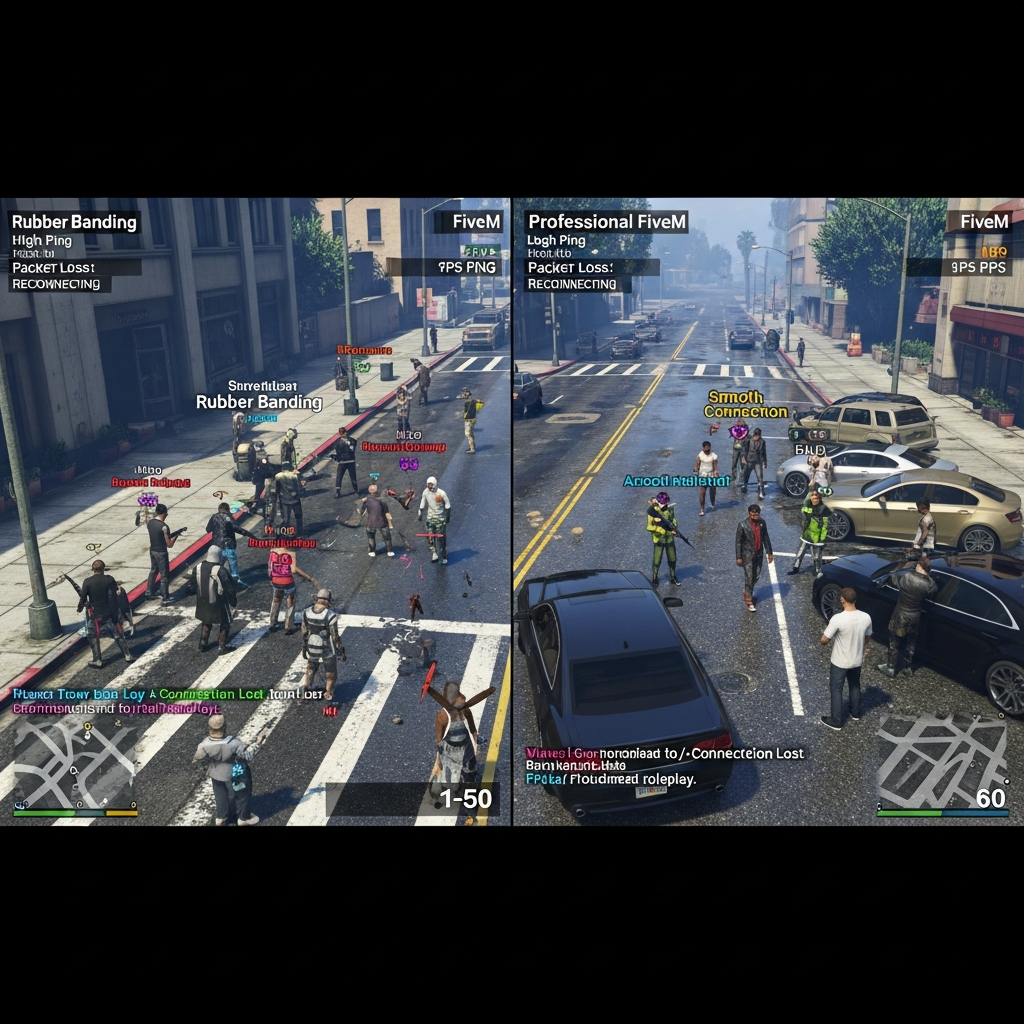
A healthy server allocates ≤2 ms/frame per core resource. Free hosts often show 8–15 ms/frame even at idle, causing rubberbanding and sync issues. Next, install a lightweight script like pNotify and trigger 50 notifications simultaneously—free servers will stutter or crash, while production infrastructure on a Ryzen 9 7950X3D (16 cores / 32 threads at 5 GHz) handles this without frame drops.
2. Multi-Player Stress Test
Invite 10–15 players to join during a 30-minute session. Monitor with:
txAdmin
# Check real-time graphs for RAM usage, CPU %, player count
Free hosts cap out at 8–12 players before latency exceeds 150 ms. You’ll also notice the server kicking players with “timed out” errors—a symptom of insufficient network bandwidth (free plans rarely exceed 100 Mbps shared). In contrast, a properly configured FiveM server on Nexus Games infrastructure with 1 Gbps dedicated bandwidth maintains sub-50 ms ping even at 128 slots.
3. Mod Compatibility Check
Upload a popular resource pack (e.g., ESX Legacy + MySQL) via FTP. Free hosts typically:
- Block FTP entirely, forcing file uploads through a sluggish web interface (10 KB/s max).
- Reject large archives over 50 MB, making ESX installation impossible.
- Lack MySQL access—you’ll need to rent a separate database host, adding latency (100+ ms queries vs. <5 ms on co-located DB).
Professional hosts include one-click txAdmin setup with pre-configured MySQL databases, automated backups, and mod managers. The time saved alone justifies the $2.94/month entry cost for a FiveM server powered by DDR5 ECC RAM and NVMe storage.
4. Uptime Monitoring
Deploy an external monitor like UptimeRobot (free tier) to ping your server IP every 5 minutes. Over 7 days, free hosts average 85–92% uptime with unannounced maintenance windows. Production servers with enterprise hardware and redundant power supplies achieve 99.9% SLA.
Document every crash in a spreadsheet: timestamp, active player count, and loaded resources. Pattern analysis reveals free hosts often force-restart servers every 6–12 hours to “reclaim” resources for other users—unacceptable for roleplay communities with scheduled events.
Why Free Hosting Fails for Serious FiveM Projects
Beyond performance, free FiveM hosting introduces systemic risks that endanger your community’s growth. Consider the technical stack: FiveM is a CPU-bound application requiring single-thread performance above 4.5 GHz (base clock) to handle OneSync, player synchronization, and script compilation. Free hosts run outdated Xeon E5 processors (2012–2016 era) locked at 2.4–3.0 GHz, causing constant hitching during vehicle spawns or model streaming.
Storage Bottlenecks
Free plans use mechanical HDDs (5400 RPM SATA) or entry-level SATA SSDs with 300 MB/s read speeds. Loading a 10 GB resource pack takes 35+ seconds per player join. Meanwhile, NVMe Gen4 SSDs (7000 MB/s sequential read) on Nexus Games infrastructure load the same pack in under 2 seconds—critical for retaining impatient players who alt-tab during long loading screens.
No Patreon Key = No Scalability
Every FiveM server exceeding 48 players must link a Patreon Tier subscription ($15–30/month) to Cfx.re. Free hosts never include this, capping your server at 32–48 slots permanently. When your community outgrows this limit, you’ll be forced to migrate—a painful process involving:
- Exporting databases (if FTP even works).
- Reconfiguring
server.cfgwith new IP/ports. - Updating whitelist scripts, Discord integrations, and CAD systems.
- Notifying players of downtime (often 6–12 hours for inexperienced admins).
Choosing a provider that bundles Patreon keys—like Nexus Games—eliminates this friction. Your server scales from 32 to 128 slots with a single billing upgrade, zero downtime, and automatic key provisioning.
Security Vulnerabilities
Free hosts rarely patch exploits. The 2024 FiveM exploit wave (CVE-2024-XXXX) allowed attackers to inject malicious Lua code into unpatched servers, stealing player tokens and server resources. Paid providers applied patches within 24 hours; free hosts took 3–6 weeks, leaving thousands of servers compromised. Additionally, shared IP addresses on free plans mean if a neighboring server gets DDoSed, your server suffers collateral packet loss—mitigated by dedicated IPs and Game Anti-DDoS systems on enterprise hosts.
For authoritative guidance on FiveM security best practices, consult the official Cfx.re documentation.

The True Cost of “Free”: Hidden Expenses and Alternatives
While marketing suggests $0 monthly fees, testing free FiveM hosting reveals hidden costs that quickly exceed budget-friendly paid plans. You’ll spend 10–15 hours troubleshooting crashes, optimizing configs for limited RAM, and appealing arbitrary suspensions. At $25/hour (modest freelance rate), that’s $250–375 in lost productivity—enough to fund 3–6 months of professional hosting.
Factor in opportunity costs: every hour debugging why your free server won’t load vMenu is an hour not spent building your community, designing custom scripts, or marketing your server. Premium hosting with 24/7 support resolves these issues via ticket in under 30 minutes, allowing you to focus on content creation.
Entry-Level Paid Hosting: The Smart Alternative
At $2.94/month, Nexus Games FiveM plans include everything free hosts omit:
| Feature | Free Hosting | Nexus Games ($2.94/mo) |
| Processor | Xeon E5 (2.4 GHz, 2012) | Ryzen 9 7950X3D (5 GHz, 2023) |
| RAM | 512 MB – 1 GB shared | 3 GB+ DDR5 ECC dedicated |
| Storage | 2–5 GB HDD | 15 GB+ NVMe SSD |
| Patreon Key | ❌ Never included | ✅ Included (48+ slots) |
| MySQL Database | ❌ External only | ✅ Co-located, <5 ms latency |
| DDoS Protection | ❌ Shared IP, no mitigation | ✅ Game-specific filtering |
| Support | ❌ Community forums | ✅ 24/7 ticket + Discord |
The performance gap is irrefutable: a $2.94/month server handles 32 players at 60 TPS (ticks per second) with 20+ vehicle mods, EUP clothing, and custom MLOs. Free servers struggle to maintain 20 TPS with 8 players and zero mods.
When Free Hosting Makes Sense
Use free FiveM hosting exclusively for:
- Solo script development: Testing Lua syntax or debugging resource manifests offline.
- 48-hour trials: Validating txAdmin features before committing to paid plans.
- Educational purposes: Teaching students server administration basics (not live communities).
Never rely on free hosting for public servers, whitelisted RP communities, or any project where uptime and player experience matter. The reputational damage from constant crashes outweighs the $35/year saved.
Conclusion
Testing FiveM free hosting in 2025 exposes fundamental limitations: throttled CPUs, microscopic RAM allocations, and missing Patreon keys render these services unsuitable for real communities. While free plans serve narrow use cases like solo development, any server expecting 10+ concurrent players demands dedicated resources—starting at $2.94/month with enterprise-grade AMD Ryzen 9 7950X3D processors, DDR5 ECC memory, and NVMe storage. Invest in infrastructure that scales with your ambitions, not against them.
FAQ
Can I migrate from free FiveM hosting to paid hosting without data loss?
Yes, but it requires manual steps. Export your resources folder via FTP (if available), dump MySQL databases using phpMyAdmin, and save your server.cfg. Upload these to your new host’s file manager, reconfigure database credentials in server.cfg, and update your server IP in Discord integrations. Professional hosts like Nexus Games offer migration assistance to automate this process and minimize downtime.
Why do free FiveM servers crash when loading custom cars or EUP?
Custom vehicle models (especially 4K liveries) and EUP clothing packs require 3–5 GB RAM minimum. Free hosts cap RAM at 512 MB–1 GB, causing out-of-memory crashes. Additionally, slow HDD storage takes 20+ seconds to stream assets, triggering timeout disconnects. Upgrading to NVMe SSD hosting with 4+ GB DDR5 ECC RAM eliminates these crashes entirely.
Do free FiveM hosts allow OneSync Infinity or are slots artificially limited?
Free hosts block OneSync Infinity (128+ player support) by refusing to provide Patreon keys, which OneSync requires. Even if you manually add your own key, resource throttling makes 64+ players unplayable. Servers serious about high slot counts need dedicated CPU threads and 1 Gbps bandwidth—features exclusive to paid infrastructure with Ryzen 9 7950X3D processors and Game Anti-DDoS protection.