Choosing dedicated FiveM server hosting in 2025 requires understanding performance benchmarks, infrastructure quality, and provider capabilities that directly impact player experience. This comprehensive guide explores the technical requirements, configuration best practices, and hosting solutions that ensure your FiveM server delivers optimal performance, stability, and scalability for roleplay communities of any size.
What Makes Dedicated FiveM Server Hosting Different in 2025?
Unlike shared hosting environments where resources fluctuate based on neighboring tenants, dedicated FiveM server hosting provides isolated CPU cores, guaranteed RAM allocation, and dedicated bandwidth. This architecture becomes critical when running resource-intensive frameworks like ESX, QBCore, or custom scripts that demand consistent processing power.
The FiveM multiplayer modification for Grand Theft Auto V requires substantial computational resources due to its synchronization engine, script execution layers, and asset streaming systems. A dedicated environment ensures that CPU-intensive operations—player position updates, physics calculations, vehicle syncing, and script loops—execute without interference from other services.
Infrastructure Requirements for FiveM in 2025
Modern FiveM servers benefit significantly from specific hardware characteristics. The AMD Ryzen 9 7950X3D processor with its 16 cores, 32 threads, and clock speeds exceeding 5 GHz provides exceptional single-thread performance crucial for FiveM’s main execution thread. This processor’s 3D V-Cache technology reduces memory latency, directly improving script response times and player synchronization accuracy.
Memory architecture matters equally. DDR5 ECC RAM ranging from 32 GB to 128 GB ensures not only capacity for large player bases but also error correction that prevents data corruption during long-running sessions. ECC memory detects and corrects single-bit errors automatically, maintaining server stability during intensive operations like mass player events or complex script executions.
| Component | Specification | Impact on FiveM |
| Processor | AMD Ryzen 9 7950X3D (16C/32T @ <5 GHz) | Handles script execution, player sync, physics |
| Memory | DDR5 ECC 32–128 GB | Supports large player counts, prevents crashes |
| Storage | NVMe SSD | Reduces asset load times, improves streaming |
| Network | 1 Gbps dedicated | Ensures low latency, stable connections |
Storage speed directly affects player join times and asset streaming. NVMe SSD storage delivers read speeds exceeding 3,000 MB/s, enabling rapid loading of custom maps, vehicle models, and script resources. This becomes particularly important for servers with extensive custom content libraries exceeding 10 GB.

Patreon Key Integration and Licensing Requirements
All legitimate FiveM servers require a Patreon key (previously known as “element club argentum” or similar tiers) for access to enhanced features and increased player slots beyond the 32-player base limit. Quality dedicated FiveM server hosting providers include this key automatically within their service packages, eliminating additional licensing costs.
The Patreon key unlocks critical capabilities including OneSync support (enabling 128+ player slots), increased entity limits, enhanced security features, and access to the FiveM Nucleus system. Without this key, servers remain limited to basic functionality unsuitable for serious roleplay communities.
Server Configuration Best Practices
Proper server.cfg configuration maximizes performance on dedicated hardware. Key parameters include:
sv_maxclients 64
sv_licenseKey "your_patreon_key_here"
onesync on

set mysql_connection_string "mysql://user:password@localhost/database"
set steam_webApiKey "your_steam_api_key"

sv_enforceGameBuild 2802
sv_scriptHookAllowed 0

exec resources.cfg
The sv_maxclients value should align with your hosting resources. A 64-player server on a Ryzen 9 7950X3D with 32 GB RAM operates comfortably with headroom for script overhead. Larger communities requiring 128+ slots benefit from 64–128 GB RAM configurations.
Database optimization significantly impacts performance. FiveM servers using ESX or QBCore frameworks rely heavily on MySQL queries for player data, inventory systems, and persistent world state. Hosting this database locally on the same NVMe SSD reduces query latency from 50+ ms (remote database) to under 1 ms (local), improving script responsiveness noticeably.
Resource Management and Script Optimization
FiveM’s resource system allows extensive customization but requires careful management. Monitor resource consumption using the built-in profiler:
profiler record 60
profiler save
This captures 60 seconds of performance data, identifying scripts consuming excessive CPU time. Common culprits include poorly optimized vehicle shops, badly coded phone scripts, and inefficient loop implementations. Resources consistently exceeding 2-3 ms per tick warrant optimization or replacement.
Threading optimization improves multi-core utilization. While FiveM’s main execution thread remains single-threaded, asynchronous operations and native callbacks can leverage additional cores. The 32 threads available on the Ryzen 9 7950X3D handle background tasks like database queries, file operations, and network I/O without impacting main thread performance.
Choosing the Right Dedicated Hosting Solution
Selecting dedicated FiveM server hosting involves evaluating several critical factors beyond raw specifications. Provider expertise with FiveM’s unique requirements, management panel capabilities, support responsiveness, and network infrastructure quality all influence long-term success.
KVM Virtualization vs. Container-Based Solutions
For servers requiring full control and guaranteed resources, KVM virtualization provides true hardware isolation. Unlike container technologies (Docker, LXC) that share kernel resources, KVM allocates dedicated CPU cores, memory, and I/O channels exclusively to your instance. This prevents “noisy neighbor” issues where other tenants’ resource spikes impact your server performance.
KVM-based VPS solutions suitable for FiveM offer full root access, enabling kernel-level optimizations, custom networking configurations, and direct hardware control. This becomes essential when running additional services alongside FiveM—dedicated TeamSpeak servers, web panels, or Discord bots—all managed from a unified control panel.
Panel Management Capabilities
Modern hosting panels designed for game servers should provide one-click operations for common tasks: server restarts, resource installation, database management, and file editing. The Nexus Games Panel offers direct FiveM integration with automated txAdmin deployment, one-click backups, and real-time resource monitoring without requiring SSH expertise.
Advanced users benefit from SSH access for custom configurations, automated deployment scripts, and integration with external tools. A quality panel balances accessibility for beginners with power-user features for experienced administrators.
Network Infrastructure and DDoS Protection
FiveM servers face constant connection attempts from malicious actors seeking to disrupt service. Game-specific Anti-DDoS protection filters illegitimate traffic patterns while allowing genuine player connections through without latency penalties. Generic DDoS solutions often introduce 20-50 ms additional latency; game-optimized systems maintain sub-5 ms overhead.
Network backbone quality affects player experience globally. A 1 Gbps dedicated connection ensures sufficient bandwidth for 64+ concurrent players streaming custom assets, voice chat data, and game state synchronization. Providers with peering agreements at major internet exchanges (DE-CIX, AMS-IX, LINX) deliver lower latency to European, North American, and international player bases.
Pricing Considerations for 2025
Quality dedicated FiveM server hosting with included Patreon keys typically ranges from $2.94 monthly for entry-level configurations (16 slots, 8 GB RAM) to $50+ for premium setups supporting 128+ players with extensive resources. This pricing includes the Patreon key value ($15-30/month standalone), making bundled offerings significantly more economical.
When evaluating costs, calculate total ownership including licensing, management time, and potential downtime costs. A slightly higher monthly investment in proven infrastructure often costs less than recovering from data loss or managing frequent performance issues on budget providers.
For serious roleplay communities, consider the provider’s track record with FiveM specifically. Experience with txAdmin installations, common framework troubleshooting (ESX, QBCore), and understanding of FiveM’s unique networking requirements distinguishes specialized providers from generic VPS offerings. Nexus Games’ FiveM server hosting includes this specialized expertise alongside the technical infrastructure.
Performance Optimization and Monitoring
Maintaining optimal performance on dedicated FiveM server hosting requires continuous monitoring and proactive optimization. Establish baseline metrics during low-load periods to identify degradation trends before they impact player experience.
Key Performance Indicators
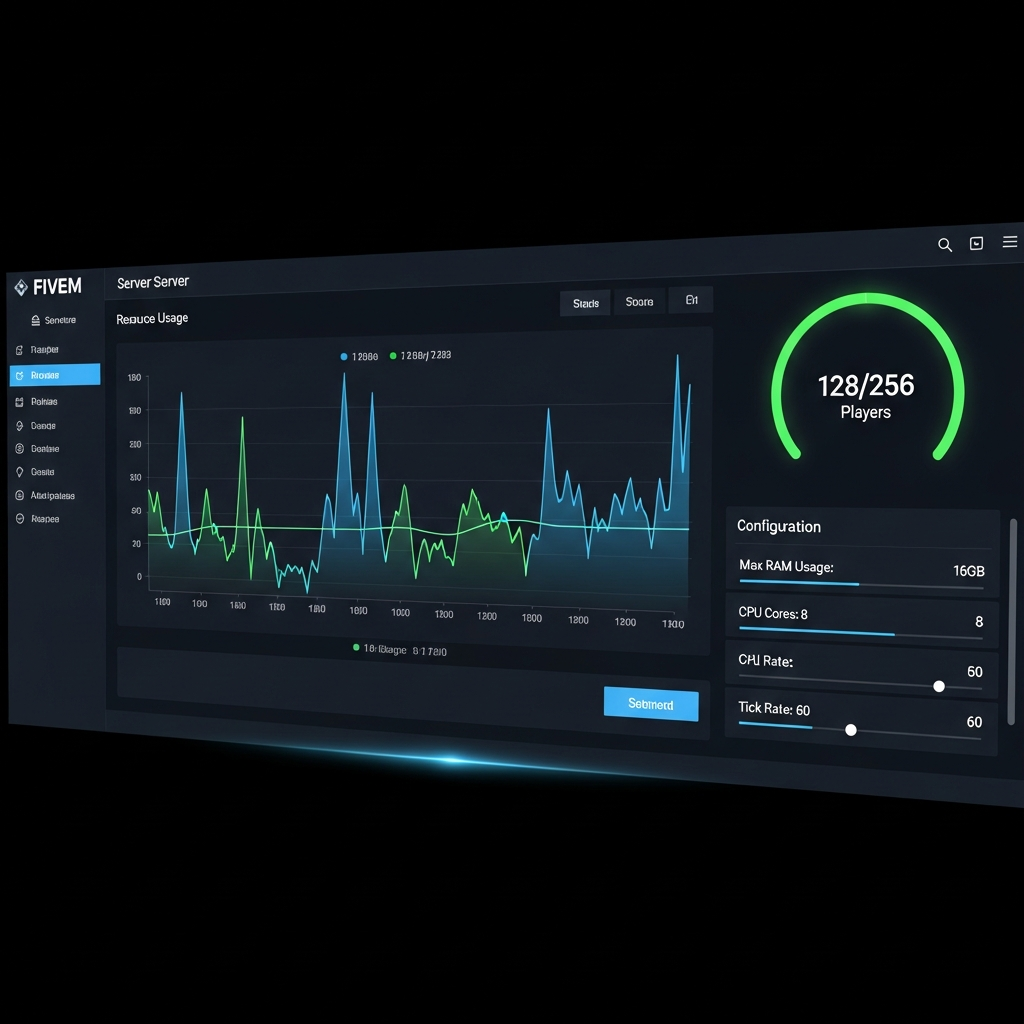
- Server Tick Rate: Should maintain consistent 60 ticks/second under normal load; drops below 50 indicate performance issues
- Player Ping: Target sub-50 ms for local players, sub-150 ms for international connections
- Script Response Time: Individual resources should complete execution within 2-3 ms per frame
- Database Query Latency: Queries should complete within 1-5 ms on local databases
- Memory Usage: Stable pattern without continuous growth indicating memory leaks
Implement automated monitoring using tools like Grafana with FiveM-specific collectors. Track these metrics over time to identify performance degradation patterns correlating with specific resource additions or player count thresholds.
Scaling Strategies
As communities grow beyond single-server capacity (typically 128-200 players maximum), consider architectural approaches:
Horizontal Scaling: Deploy multiple FiveM instances handling different geographic regions or game modes (roleplay, racing, freeroam), each on dedicated hardware. This distributes load while maintaining manageable player counts per instance.
Vertical Scaling: Upgrade to higher RAM allocations (64-128 GB) and increased CPU core counts for single-server player count increases. The Ryzen 9 7950X3D’s 16 cores support up to 200 players with optimized scripts and frameworks.
Infrastructure Separation: Offload database operations to dedicated MySQL servers, web interfaces to separate web hosting, and voice services to external platforms. This isolates resource consumption and simplifies troubleshooting.
Backup and Disaster Recovery
Implement automated daily backups of critical server components: the resources folder, server.cfg, database dumps, and txAdmin configurations. Store backups on separate storage infrastructure (not the same NVMe SSD) to protect against hardware failures.
Test restore procedures monthly to verify backup integrity and document recovery time objectives. A quality hosting provider offers one-click restore capabilities through their management panel, reducing downtime from hours to minutes during critical failures.
For additional resilience, consider providers offering Linux VPS hosting with KVM virtualization for running secondary backup servers or development environments that mirror production configurations. This enables thorough testing of framework updates, new resources, and configuration changes before deploying to the live player-facing server.
Security hardening should include regular txAdmin updates, firewall configuration limiting access to game ports only, and periodic password rotation for panel access, database credentials, and SSH keys. FiveM’s native security features combined with dedicated infrastructure provide strong protection against common attack vectors when properly configured.
For comprehensive server security guidance and best practices, consult the official FiveM documentation which provides detailed configuration references and security recommendations directly from the development team.
Conclusion
Selecting the right dedicated FiveM server hosting in 2025 demands careful evaluation of processor performance, memory architecture, storage speed, and network quality. Modern infrastructure built on AMD Ryzen 9 7950X3D processors with DDR5 ECC RAM, NVMe storage, and included Patreon keys provides the foundation for stable, scalable roleplay communities. Prioritize providers offering game-specific expertise, KVM virtualization, comprehensive management panels, and robust DDoS protection to ensure long-term success and exceptional player experiences.
FAQ
What RAM allocation is recommended for a 64-player FiveM server with ESX framework?
A 64-player FiveM server running ESX or QBCore typically requires 32 GB of DDR5 ECC RAM for comfortable operation. This allocation provides headroom for the framework’s database operations, script execution, and player synchronization. Servers with extensive custom resources (100+ scripts, large maps, custom vehicles) benefit from 64 GB to prevent memory-related performance degradation during peak player counts.
Why is the Patreon key included in dedicated FiveM hosting packages important?
The Patreon key (licensing tier) unlocks OneSync functionality essential for servers exceeding 32 players, enables increased entity limits for complex roleplay servers, and provides access to enhanced security features. Hosting providers including this key automatically (valued at $15-30 monthly) eliminate additional licensing costs and simplify server setup. Without this key, servers remain limited to basic functionality unsuitable for serious communities.
How does KVM virtualization improve FiveM server performance compared to shared hosting?
KVM virtualization allocates dedicated CPU cores, guaranteed RAM, and isolated I/O channels exclusively to your FiveM instance, preventing resource contention from neighboring tenants. This ensures consistent processor availability for FiveM’s main execution thread, stable memory allocation for script operations, and predictable network performance during player synchronization. Shared hosting environments cause performance fluctuations when other services consume resources, resulting in variable tick rates and player connection issues.